cfbs add inventory-fwupd@0.2.0
Surface fwupd state as inventory attributes: current firmware versions and vendors, pending updates from LVFS, and Host Security Identifier (HSI) security posture.
Pair with manage-fwupd to optionally apply firmware updates for devices matching an allow-list.
fwupd package for full functionality (manage-fwupd installs it
automatically). Without fwupd, the module still runs but reports
Firmware update status as FWUPD_MISSING.fwupd-refresh.timer enabled so the LVFS firmware catalog stays
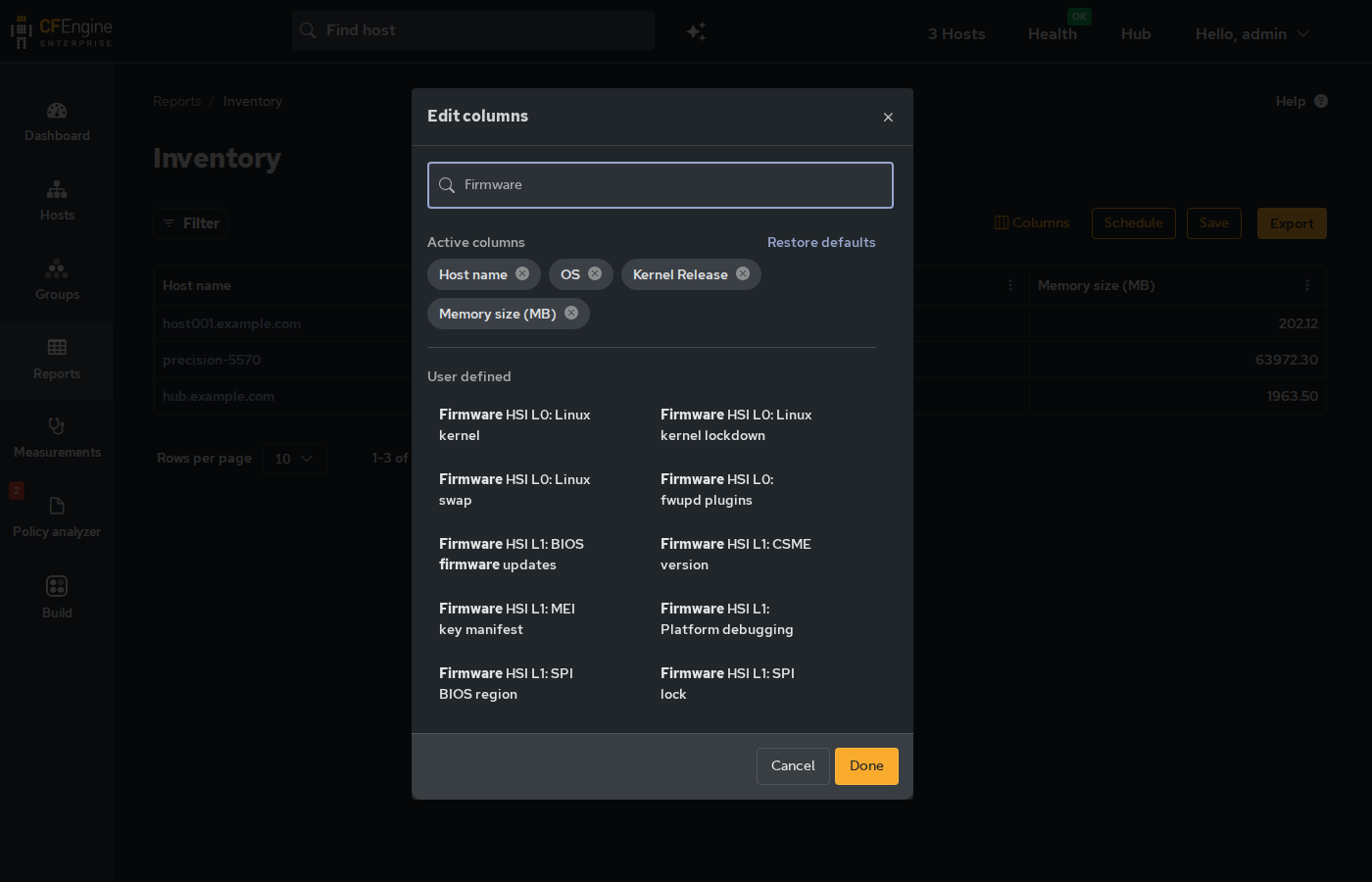
current (manage-fwupd handles this automatically)The inventory attributes appear in Mission Portal's column selector under "fwupd":

| Attribute | Values |
|---|---|
| Firmware update status | OK – no pending updates |
UPDATES_AVAILABLE – one or more devices have pending updates |
|
NO_DEVICES – fwupd present but no updatable devices |
|
FWUPD_MISSING – fwupd is not installed |
For every device fwupd reports (keyed by DeviceId):
| Attribute | Format | |||
|---|---|---|---|---|
| Firmware devices | =Name | Vendor | vX.Y.Z | [plugin]= |
| Firmware device pending update | Name: current -> new (only when an update is pending) |
| Attribute | Format |
|---|---|
| Firmware HSI level | HSI:0 through HSI:4 |
| Firmware HSI failing | L<n>: <Name> (slist) |
| Firmware HSI passing | L<n>: <Name> (slist) |
Firmware HSI level is the rolled-up Host Security Identifier level. fwupd walks levels 1–4 sequentially; the result is the highest level where all attributes pass, stopping at the first level with any failure.
Firmware HSI failing and Firmware HSI passing are slists of the
security checks fwupd reported, split by outcome (e.g. L1: TPM v2.0).
The check set is hardware dependent, so a check in neither list is not
applicable to this host. compliance-report-fwupd matches an exact item
against Firmware HSI failing for its per-check conditions.
Items keep the L<n>: prefix because the name alone is not unique:
fwupd reports two distinct checks named Platform debugging, at L1
(Intel DCI) and L2 (debug locked). Two normalizations keep items stable:
L1: CSME version regardless of the firmware version string fwupd
reports (which varies per host).UEFI secure boot is emitted
at L1 (not L0) and CET OS Support at L3 (not L0).

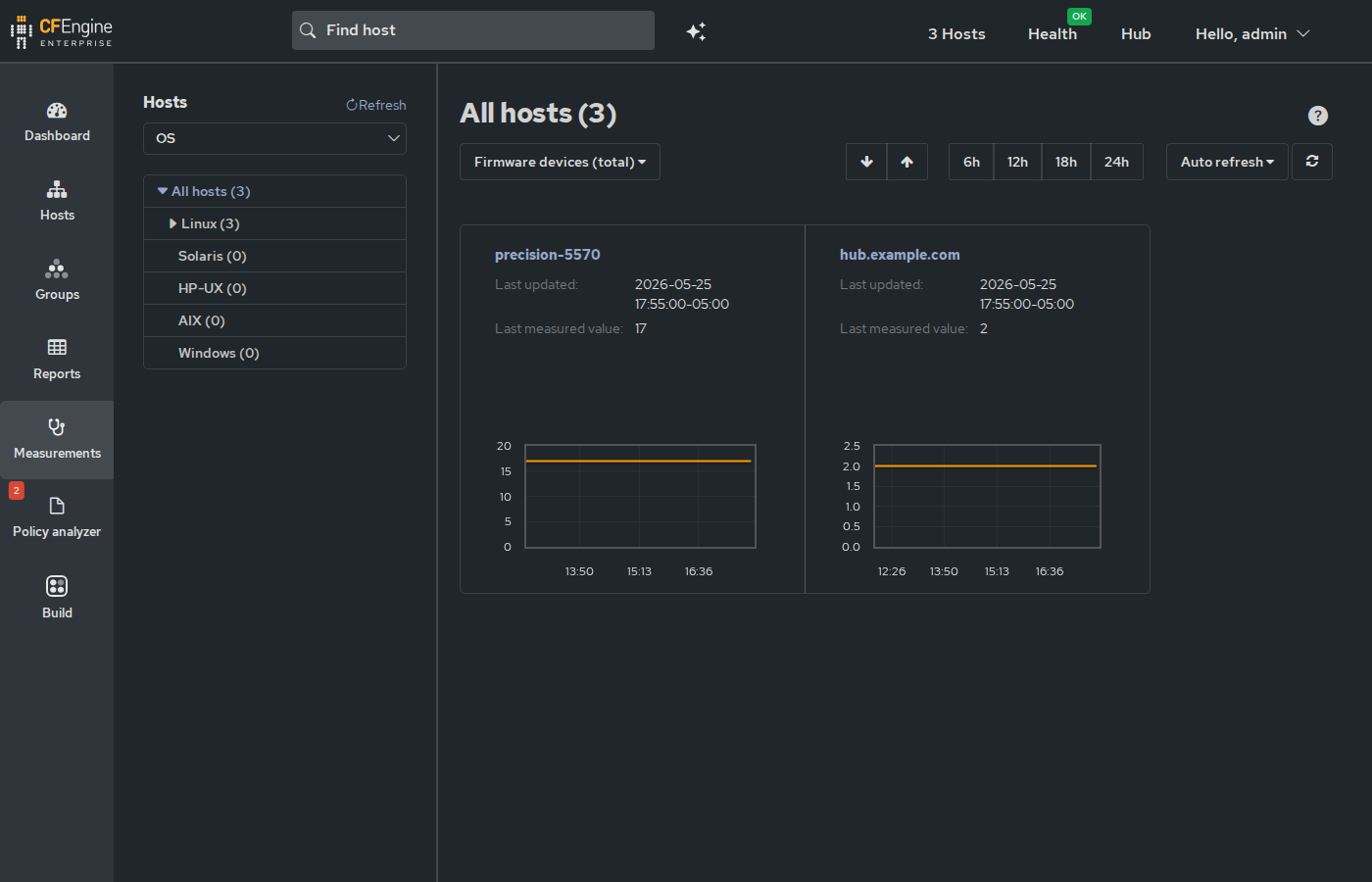
The following values are emitted as cf-monitord measurements for
time-series tracking in Mission Portal:
| Measurement | Units | Description |
|---|---|---|
firmware_devices_total |
devices | Number of devices fwupd is tracking |
firmware_updates_available |
devices | Number of devices with a pending update |
firmware_hsi_failing |
checks | Number of failing HSI security checks |
These appear in Mission Portal monitoring graphs as
firmware_devices_total, firmware_updates_available, and
firmware_hsi_failing.

The module defines namespace-scoped classes for platform-specific compliance report targeting:
| Class | Source | Matches |
|---|---|---|
fwupd_cpu_vendor_intel |
/proc/cpuinfo vendor_id |
GenuineIntel |
fwupd_cpu_vendor_amd |
/proc/cpuinfo vendor_id |
AuthenticAMD |
fwupd_oem_vendor_hp |
/sys/class/dmi/id/sys_vendor |
HP Inc. or Hewlett-Packard |
These classes are used by compliance-report-fwupd host_filter
fields to restrict Intel-only, AMD-only, and HP-only conditions to
the relevant hardware.
The module is read-only – it never applies firmware updates. Use manage-fwupd for that.
This module has no dependencies